











Enhancing Online Visibility Through Search Engine Optimization
Core Infrastructure and Authority Architecture
The digital landscape for online visibility has fundamentally changed. In October 2026, simply ranking in traditional search results is no longer enough to connect with your audience. The rise of artificial intelligence (AI) has reshaped how users find information and how businesses gain attention online.
We are seeing a profound shift. AI Overviews now appear in over 50% of Google searches, drastically altering organic click-through rates. This means your content needs to be optimized not just for search engines, but for AI systems that synthesize answers directly.
This comprehensive guide will equip you with the strategies needed to thrive in this new era. We will explore the critical differences between traditional rankings and AI citations, delve into the essential technical foundations, and show you how to build true topical authority. We’ll also cover how to measure your success in a world where AI-driven interactions are paramount, ensuring your business achieves optimal search engine optimization and online visibility.
Bridging Traditional Rankings and AI Citations for Search Engine Optimization and Online Visibility
The shift in search behavior by October 2026 is undeniable. For years, the primary goal of SEO was to secure a top-ranking position in the organic search results, driving direct clicks to a website. However, the advent of AI Overviews, AI Mode, and AI assistants like ChatGPT and Perplexity has introduced a new dimension: being cited in an AI-generated answer. This distinction is crucial for modern online visibility.
Traditional ranking focuses on an algorithm determining the most relevant link to display for a query. A click-through then brings the user to your site. In contrast, AI citation means that an AI system has extracted information directly from your content to synthesize an answer, often presented directly on the search results page or within a conversational AI interface. This has led to a significant increase in “zero-click” searches, with 58.5% of US Google searches ending without a click in 2024. When AI Overviews appear, organic click-through rates (CTR) can drop by as much as 61% (from 1.76% to 0.61%).
The implications are profound. While traditional SEO still aims for high rankings, the new landscape demands that we also optimize for AI visibility. Interestingly, only 17–38% of AI Overview citations now come from pages that also rank in the organic top 10 for that query, a sharp decline from 75% eight months earlier. This means content outside the traditional top spots can still be highly valuable to AI systems.
Pages cited within AI Overviews see a 35% increase in organic clicks and a remarkable 91% increase in paid clicks compared to competitors on the same query. Furthermore, visitors referred by Large Language Models (LLMs) convert at 4.4 times the rate of organic search visitors, indicating a highly engaged audience.
This shift means businesses must evolve their SEO strategy from merely chasing rankings to becoming a trusted source of information for AI systems. This involves focusing on semantic completeness, factual density, and clear, answer-first content that AI can easily extract and synthesize.
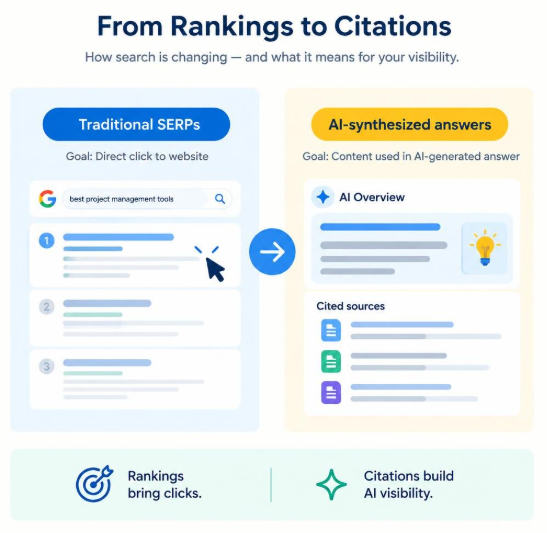
Here’s a comparison highlighting the key differences:
Traditional Organic Rankings AI Overview Citations Goal: Direct click to website Goal: Content used in AI-generated answer Primary Metric: SERP position, CTR Primary Metric: Citation frequency, brand mention, referral traffic Traffic Impact: Direct click-through Traffic Impact: Brand awareness, indirect clicks, high-converting referrals Content Focus: Keywords, relevance Content Focus: Semantic completeness, direct answers, E-E-A-T Visibility Source: Organic top 10 Visibility Source: Can be outside top 5 (47%) User Behavior: Link selection User Behavior: Answer consumption, follow-up queries To achieve visibility in this dual-faceted search landscape, a robust technical foundation and undeniable authority are paramount. We view AI search visibility through six essential layers, which should be addressed in order for maximum impact.

Technical Infrastructure and the Six Layers of AI Retrieval
The six layers of AI search visibility are:
- Access: Can AI crawlers find and read your content?
- Understanding: Can AI systems comprehend the meaning and context of your content?
- Content: Is your content valuable, unique, and structured for AI extraction?
- Authority: Does your site and brand possess the E-E-A-T signals AI systems trust?
- Local/Product Data: Is your business information consistent and optimized for specific queries?
- Measurement: Can you track and analyze your AI visibility performance?
Working through these layers sequentially is critical. If AI crawlers cannot access your site (Layer 1), then optimizing your content (Layer 3) is futile.
Technical SEO, which ensures a site is crawlable, indexable, and performs well, is the bedrock for both traditional search engines and AI systems. However, there are nuances. While Google’s traditional crawler (Googlebot) has become adept at rendering JavaScript, a Vercel and MERJ study revealed that none of the major AI crawlers rendered JavaScript. This means server-side rendering or static HTML is crucial for content you want AI systems to access and cite.
Core Web Vitals (Largest Contentful Paint, Interaction to Next Paint, Cumulative Layout Shift) remain vital. Fast-loading pages are not just good for user experience; they directly correlate with AI citation frequency. Pages with a First Contentful Paint (FCP) under 0.4 seconds average 6.7 AI citations, while those over 1.13 seconds average only 2.1. This highlights the importance of optimizing for speed, aiming for LCP under 2.5s, INP under 200ms, and CLS under 0.1.
Structured data, particularly JSON-LD, plays a significant role in helping AI systems understand your content’s context and entities. While Google states no special markup is required for AI Overviews, accurate schema (e.g., FAQPage, Article, Organization, LocalBusiness) provides a 73% citation boost from structured data by aiding disambiguation and making your content more machine-readable.
Here’s how technical requirements compare for traditional vs. AI crawlers:
Technical Requirement Traditional Search Engine Bots AI Crawler Systems Crawlability
HTML, CSS, JS (often rendered) Raw HTML, server-side rendered JS (most don’t render client-side JS) Core Web Vitals Ranking factor, user experience Strong correlation with AI citations (e.g., FCP < 0.4s) Structured Data (JSON-LD) Rich results, enhanced understanding Aids disambiguation, 73% citation boost Robots.txt Critical for access control Essential for AI crawlers to access content Indexing Granularity Page-level Content-fragment level for synthesis
Building Topical Authority and Entity Trust Over Domain Metrics
In the AI-semantic era of 2026, the concept of authority has evolved. While domain authority once reigned supreme, its correlation with AI citation probability has plummeted to near-zero (r=0.18, down from 0.43 pre-2024). Instead, topical authority and entity trust are the new predictors of AI citation.
Topical authority refers to the depth and trustworthiness of a site’s coverage on a specific subject. AI systems are designed to synthesize information from multiple sources to provide comprehensive answers. They value sites that demonstrate a complete understanding of a topic, covering all its sub-queries and related concepts. This is best achieved through a topic cluster architecture, where a central “pillar” page broadly covers a subject, and numerous “cluster” pages delve into specific sub-topics, all interconnected through internal linking.

Semantic completeness is now the strongest predictor of AI Overview selection (r=0.87 correlation). This means providing thorough, factual, and well-organized information that leaves no stone unturned within a given topic. AI-cited articles, for instance, cover 62% more facts than non-cited ones and are significantly longer, averaging 5.1 AI citations for pieces over 2,900 words versus 3.2 for those under 800 words.
Alongside topical authority, E-E-A-T (Experience, Expertise, Authoritativeness, Trustworthiness) is a critical signal. It comes in second at r=0.81, and a staggering 96% of AI Overview content comes from sources with verifiable E-E-A-T signals. This means showcasing the real-world experience and credentials of authors, ensuring content is factually accurate, and building a reputation as a trusted voice in your industry.
This entity-level trust extends beyond your website, encompassing consistent brand information, knowledge panel verification, and third-party mentions across the web. For businesses looking to maximize their reach, a comprehensive strategy that combines strong organic presence with targeted advertising can be incredibly powerful. We often see clients benefit from an integrated SEO and PPC approach, where insights from one channel inform and amplify the other, creating a holistic visibility strategy.
Strategic Execution, Attribution, and Modern Best Practices
Navigating the complexities of AI-driven search requires a refined approach to content creation, measurement, and overall strategy.
Content Structuring and Multi-Channel Synergy for Search Engine Optimization and Online Visibility
The way we structure content directly impacts its likelihood of being cited by AI systems. Here are high-impact AI citation formatting elements:
- Direct-Answer Openings: Start your content, or key sections, with a concise, direct answer to the question posed in the heading. This makes it easy for AI to extract the core information.
- FAQPage Schema: Implementing FAQPage schema is highly effective for content structured as questions and answers. While Google stopped showing FAQ rich results for most sites in May 2026, the underlying structured data still helps AI systems understand and extract specific answers.
- Semantic Completeness: Ensure your content thoroughly covers a topic, addressing all related sub-questions and concepts. AI systems prioritize comprehensive sources.
- Conversational Intent & Long-Tail Queries: With 70% of voice queries now phrased in natural, conversational language and 46% of AI Overview-triggering queries being long-tail (7+ words), content should be written to answer these specific, natural language questions.
- Multi-Modal Content: Incorporating text, images, and structured data significantly boosts AI Overview selection rates (156% higher than text-only pages). Visuals, tables, and diagrams aid comprehension for both users and AI.
For specialized fields, like legal services, the ability to present complex information clearly and authoritatively is paramount. Leveraging law firm data and analytics can help identify the precise questions potential clients are asking, allowing you to create highly targeted, AI-citation-ready content. This data-driven approach ensures your content directly addresses user intent, increasing its chances of being selected by AI systems.
Analytics, Attribution, and Fast-Track Execution for New Domains
Measuring visibility in AI search requires moving beyond traditional ranking reports. We need new metrics and approaches:
- GA4 Custom Channel Grouping: Set up custom channel groups in Google Analytics 4 to track AI referral traffic from platforms like openai.com, perplexity.ai, claude.ai, and bing.com. This allows us to attribute conversions and user behavior directly to AI sources.
- Search Console’s Generative AI Performance Report: Monitor this report for insights into how your content is performing in AI Overviews and other generative experiences.
- Systematic Prompt Testing: Regularly test key queries in various AI assistants (ChatGPT, Perplexity, Gemini, etc.) to see if your brand or content is cited. This provides direct feedback on your AI visibility.
- Brand Search Volume: This is the strongest single predictor of AI citation frequency (r=0.334). Growing your brand’s search volume indicates increased recognition and trust, which AI systems often reflect in their citations.
- E-E-A-T Signals: Continuously build and showcase E-E-A-T through author bios, case studies, testimonials, and external mentions.
Certain common SEO tactics are now ineffective or even harmful for AI search visibility:
- Keyword Stuffing: AI systems prioritize natural language and semantic understanding; keyword stuffing is counterproductive and can lead to penalties.
- City-Swap Pages / Programmatic SEO Pitfalls: Creating hundreds of near-duplicate pages for every city or minor variation is seen as spam by Google and AI systems. Focus on unique, valuable content for each location or service.
- Chasing Domain Authority: As noted, domain authority has a near-zero correlation with AI citation. Resources are better spent on topical authority and E-E-A-T.
For a brand-new website with no existing authority, earning AI citations within 60–90 days is ambitious but achievable with a focused strategy:
- Narrow Niche Focus: Target a very specific, underserved niche to establish authority quickly.
- Question-Format Content: Structure all content around common questions, using H2/H3 headings as direct questions and providing concise answers immediately.
- Implement FAQPage Schema from Day One: Ensure your content is machine-readable for AI extraction.
- Build E-E-A-T: Feature expert authors with verifiable credentials. Actively pursue opportunities like HARO (Help A Reporter Out) or publish thought leadership on platforms like LinkedIn to build external mentions and demonstrate expertise.
- Focus on Semantic Completeness: Even for a new site, ensure your initial content is incredibly thorough and factually dense for its chosen sub-topics.
Here’s a comparison of SEO milestones for new vs. legacy domains:
Criteria Brand-New Website (60-90 Days) Legacy Website (Ongoing) Primary Focus Niche topic, E-E-A-T, direct answers Content gap analysis, topical expansion, technical health Content Strategy Question-format, FAQPage schema, highly focused Semantic completeness, multi-modal updates, content clusters Technical SEO Crawlability, Core Web Vitals from day 1 Ongoing CWV, structured data audit, JS rendering optimization Authority Building Author bios, HARO, LinkedIn publishing Link building, brand mentions, entity consistency, PR Measurement Branded search growth, AI citation monitoring GA4, Search Console, prompt testing, conversion tracking
In 2026, online visibility is no longer a singular pursuit of search engine rankings. It’s about being present, understood, and trusted across a fragmented, AI-driven digital ecosystem. By embracing technical excellence, building deep topical authority, and strategically structuring content for AI consumption, businesses can ensure they are not just found, but chosen, in this new era of search.