












Hexadecimal to Binary Conversion Examples
Hexadecimal to Binary Conversion is an important topic in number system conversion used in computer science, programming, and digital electronics. It helps students understand how base-16 numbers can be easily converted into base-2 using a direct 4-bit mapping technique. This concept is widely used in memory addressing, machine code representation, and low-level computing operations.
In this article, we will discuss hexadecimal to binary conversion examples and some examples of the fractional part as well. Let’s start
Understanding Hexadecimal to Binary Conversion
Hexadecimal to binary conversion is a quick and efficient method because each hexadecimal digit directly corresponds to a 4-bit binary number. This makes it easier to convert large numbers without complex calculations.
1. What is Hexadecimal Number System?
The hexadecimal number system is a base-16 number system that uses digits from 0–9 and letters A–F.
- Base: 16
- Digits: 0,1,2,3,4,5,6,7,8, 9, A, B, C, D, E, F
- Each position represents powers of 16
2. What is Binary Number System?
The binary number system is a base-2 number system used internally by computers.
- Base: 2
- Digits: 0 and 1
- Each position represents powers of 2
3. Relationship Between Hexadecimal and Binary
Hexadecimal and binary are closely related because:
- 16 = 2⁴
This means:
- 1 hexadecimal digit = 4 binary bits
No division or multiplication required. The direct substitution method is used
Hexadecimal to Binary Conversion Methods
There are two main methods for converting hexadecimal to binary:
1. Hexadecimal to Binary Conversion using Standard Table
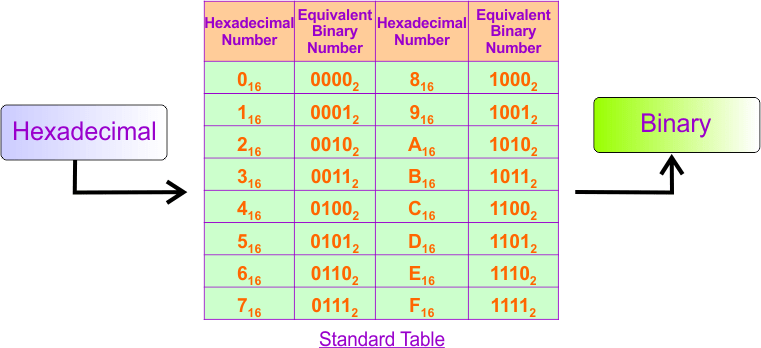
In this method, each hexadecimal digit is directly converted into its equivalent 4-bit binary form using a standard conversion table.
2. Hexadecimal to Binary Conversion using the Decimal Number System
In this method, the hexadecimal number is first converted into a decimal number, and then the decimal number is converted into binary.

Let’s explain both methods with examples
1. Hexadecimal to Binary Conversion using Standard Table
The hexadecimal to binary conversion table helps students quickly map each hexadecimal digit to its binary equivalent. This table is essential for solving problems efficiently.
The list of hexadecimal digits and their binary equivalents is given below:
Steps for Hexadecimal to Binary Conversion using Standard Table
Hexadecimal to binary conversion is a simple process based on direct substitution, where each hexadecimal digit is converted into a 4-bit binary value. This method is widely used in computer science for fast and accurate conversion between number systems. The step-by-step process with a simple example is given below.
Step 1: Write the Given Hexadecimal Number
Start by writing the hexadecimal number clearly, ensuring each digit is separated if needed.
- Example: (2A)₁₆
Step 2: Convert Each Hexadecimal Digit into 4-bit Binary
Replace each hexadecimal digit with its corresponding 4-bit binary equivalent using the standard table.
- 2₁₆ = 0010₂
- A₁₆ = 1010₂
Step 3: Combine All Binary Groups
Join all the binary groups (created in step 2) together to form the final binary number.
- 0010₂ + 1010₂ = 00101010₂
Step 4: Remove Leading Zeros (If Required)
Remove unnecessary leading zeros to simplify the final binary result.
- 00101010₂ = 101010₂
Examples are the best way to understand hexadecimal to binary conversion in a practical and exam-oriented manner. Below are solved examples with step-by-step explanations.
The list of solved examples is given below:
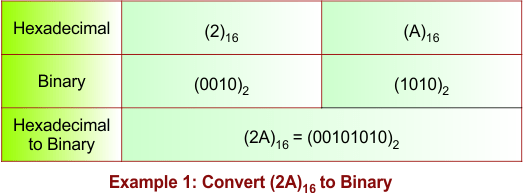
Example 1: Convert (2A)₁₆ to Binary
Solution:
The following diagram shows the conversion of the hexadecimal number (2A)₁₆ into its equivalent binary.
Description:
By replacing each hexadecimal digit with its corresponding 4-bit binary equivalent using the standard table, we get the binary of (2A)₁₆
- The binary of 2₁₆ is 0010₂
- The binary of A₁₆ is 1010₂
By joining all the binary groups together to form the final binary number. So, the final result is:
(2A)₁₆ = 00101010₂
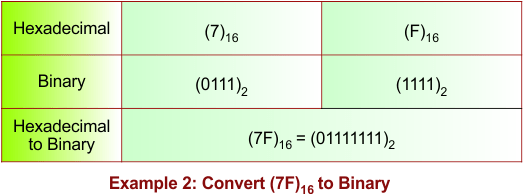
Example 2: Convert (7F)₁₆ to Binary
Solution:
The following diagram shows the conversion of the hexadecimal number (7F)₁₆ into its equivalent binary.
Description:
- The binary of 7₁₆ is 0111₂
- The binary of F₁₆ is 1111₂
(7F)₁₆ = 01111111₂
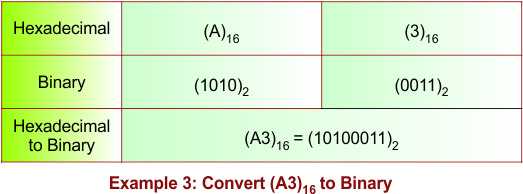
Example 3: Convert (A3)₁₆ to Binary
Solution:
The following diagram shows the conversion of the hexadecimal number (A3)₁₆ into its equivalent binary.
Description:
- The binary of A₁₆ is 1010₂
- The binary of 3₁₆ is 0011₂
(A3)₁₆ = 10100011₂
Example 4: Convert (1B7)₁₆ to Binary
Solution:
The following diagram shows the conversion of the hexadecimal number (1B7)₁₆ into its equivalent binary.
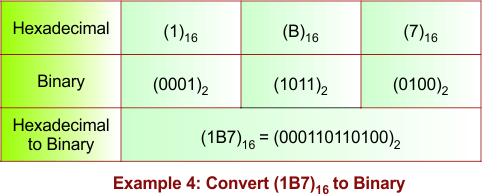
Description:
- The binary of 1₁₆ is 0001₂
- The binary of B₁₆ is 1011₂
- The binary of 7₁₆ is 0111₂
(1B7)₁₆ = 000110110111₂
Example 5: Convert (3C5)₁₆ to Binary
Solution:
The following diagram shows the conversion of the hexadecimal number (3C5)₁₆ into its equivalent binary.
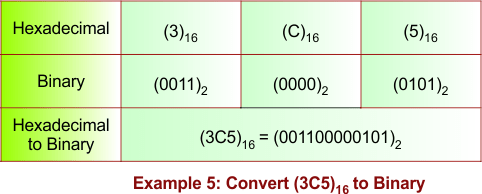
Description:
- The binary of 3₁₆ is 0011₂
- The binary of C₁₆ is 1100₂
- The binary of 5₁₆ is 0101₂
(3C5)₁₆ = 001111000101₂
Example 6: Convert (ABC)₁₆ to Binary
Solution:
The following diagram shows the conversion of the hexadecimal number (ABC)₁₆ into its equivalent binary.
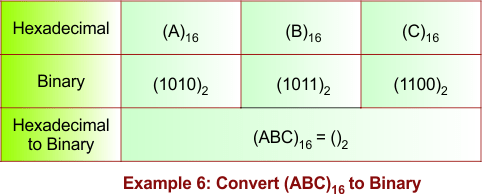
Description:
- The binary of A₁₆ is 1010₂
- The binary of B₁₆ is 1011₂
- The binary of C₁₆ is 1100₂
(ABC)₁₆ = 101010111100₂
Example 7: Convert (4D2)₁₆ to Binary
Solution:
The following diagram shows the conversion of the hexadecimal number (4D2)₁₆ into its equivalent binary.
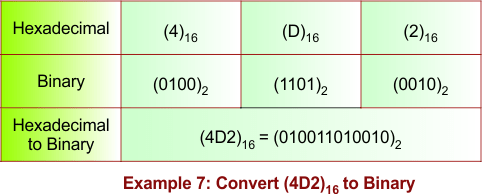
Description:
- The binary of 4₁₆ is 0100₂
- The binary of D₁₆ is 1101₂
- The binary of 2₁₆ is 0010₂
(4D2)₁₆ = 010011010010₂
Example 8: Convert (7A5)₁₆ to Binary
Solution:
The following diagram shows the conversion of the hexadecimal number (7A5)₁₆ into its equivalent binary.
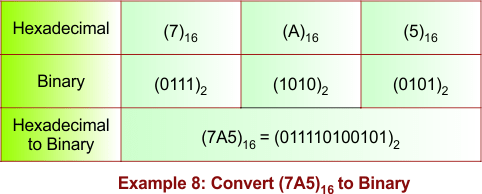
Description:
- The binary of 7₁₆ is 0111₂
- The binary of A₁₆ is 1010₂
- The binary of 5₁₆ is 0101₂
(7A5)₁₆ = 011110100101₂
Example 9: Convert (100)₁₆ to Binary
Solution:
The following diagram shows the conversion of the hexadecimal number (100)₁₆ into its equivalent binary.
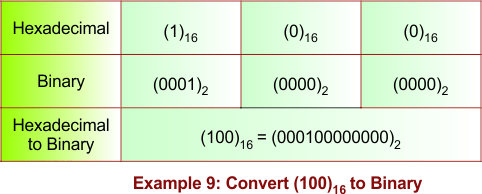
Description:
- The binary of 1₁₆ is 0001₂
- The binary of 0₁₆ is 0000₂
- The binary of 0₁₆ is 0000₂
(100)₁₆ = 000100000000₂
Example 10: Convert (5F2A)₁₆ to Binary
Solution:
The following diagram shows the conversion of the hexadecimal number (5F2A)₁₆ into its equivalent binary.
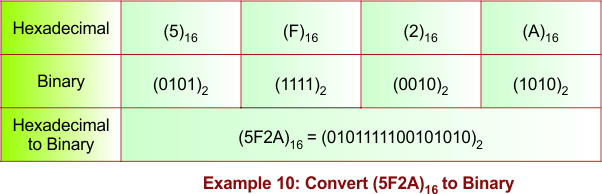
Description:
- The binary of 5₁₆ is 0101₂
- The binary of F₁₆ is 1111₂
- The binary of 2₁₆ is 0010₂
- The binary of A₁₆ is 1010₂
(5F2A)₁₆ = 0101111100101010₂
Example 11: Convert (1A3F)₁₆ to Binary
Solution:
The following diagram shows the conversion of the hexadecimal number (1A3F)₁₆ into its equivalent binary.
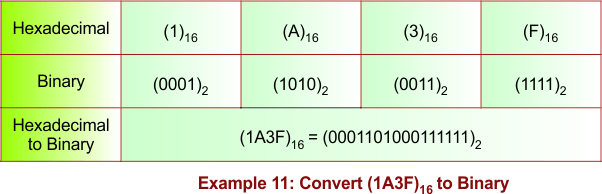
Description:
- The binary of 1₁₆ is 0001₂
- The binary of A₁₆ is 1010₂
- The binary of 3₁₆ is 0011₂
- The binary of F₁₆ is 1111₂
(1A3F)₁₆ = 0001101000111111₂
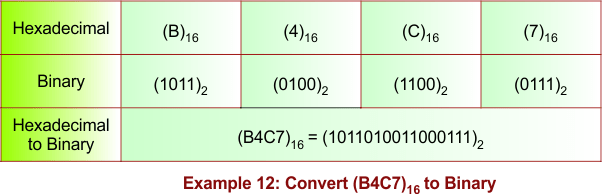
Example 12: Convert (B4C7)₁₆ to Binary
Solution:
The following diagram shows the conversion of the hexadecimal number (B4C7)₁₆ into its equivalent binary.
Description:
- The binary of B₁₆ is 1011₂
- The binary of 4₁₆ is 0100₂
- The binary of C₁₆ is 1100₂
- The binary of 7₁₆ is 0111₂
(B4C7)₁₆ = 1011010011000111₂
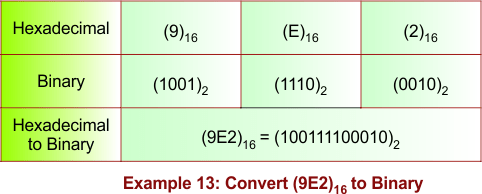
Example 13: Convert (9E2)₁₆ to Binary
Solution:
The following diagram shows the conversion of the hexadecimal number (9E2)₁₆ into its equivalent binary.
Description:
- The binary of 9₁₆ is 1001₂
- The binary of E₁₆ is 1110₂
- The binary of 2₁₆ is 0010₂
(9E2)₁₆ = 100111100010₂
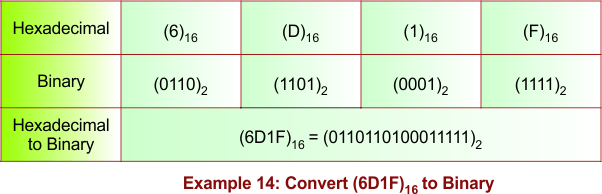
Example 14: Convert (6D1F)₁₆ to Binary
Solution:
The following diagram shows the conversion of the hexadecimal number (6D1F)₁₆ into its equivalent binary.
Description:
- The binary of 6₁₆ is 0110₂
- The binary of D₁₆ is 1101₂
- The binary of 1₁₆ is 0001₂
- The binary of F₁₆ is 1111₂
(6D1F)₁₆ = 0110110100011111₂
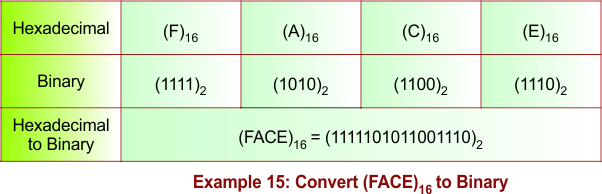
Example 15: Convert (FACE)₁₆ to Binary
Solution:
The following diagram shows the conversion of the hexadecimal number (FACE)₁₆ into its equivalent binary.
Description:
- The binary of F₁₆ is 1111₂
- The binary of A₁₆ is 1010₂
- The binary of C₁₆ is 1100₂
- The binary of E₁₆ is 1110₂
(FACE)₁₆ = 1111101011001110₂
Example 16: Convert (1A3F7)₁₆ to Binary
Solution:
The following diagram shows the conversion of the hexadecimal number (1A3F7)₁₆ into its equivalent binary.
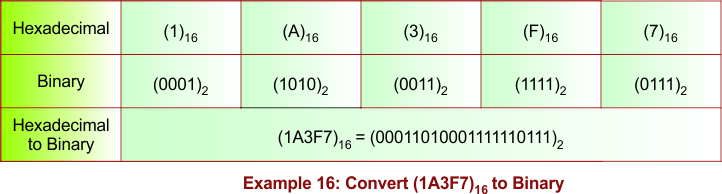
Description:
- The binary of 1₁₆ is 0001₂
- The binary of A₁₆ is 1010₂
- The binary of 3₁₆ is 0011₂
- The binary of F₁₆ is 1111₂
- The binary of 7₁₆ is 0111₂
(1A3F7)₁₆ = 00011010001111110111₂
Example 17: Convert (B7C9A)₁₆ to Binary
Solution:
The following diagram shows the conversion of the hexadecimal number (B7C9A)₁₆ into its equivalent binary.
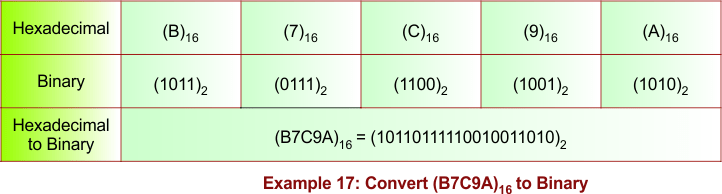
Description:
- The binary of B₁₆ is 1011₂
- The binary of 7₁₆ is 0111₂
- The binary of C₁₆ is 1100₂
- The binary of 9₁₆ is 1001₂
- The binary of A₁₆ is 1010₂
(B7C9A)₁₆ = 10110111110010011010₂
Example 18: Convert (4F2D8)₁₆ to Binary
Solution:
The following diagram shows the conversion of the hexadecimal number (4F2D8)₁₆ into its equivalent binary.
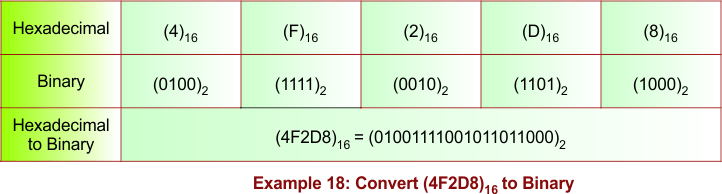
Description:
- The binary of 4₁₆ is 0100₂
- The binary of F₁₆ is 1111₂
- The binary of 2₁₆ is 0010₂
- The binary of D₁₆ is 1101₂
- The binary of 8₁₆ is 1000₂
(4F2D8)₁₆ = 01001111001011011000₂
Example 19: Convert (9ABCDE)₁₆ to Binary
Solution:
The following diagram shows the conversion of the hexadecimal number (9ABCDE)₁₆ into its equivalent binary.
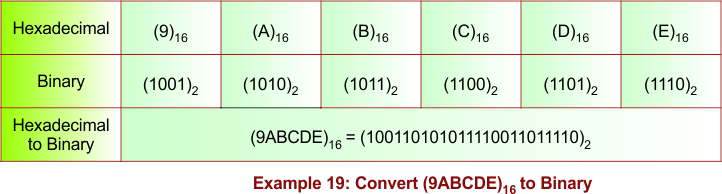
Description:
- The binary of 9₁₆ is 1001₂
- The binary of A₁₆ is 1010₂
- The binary of B₁₆ is 1011₂
- The binary of C₁₆ is 1100₂
- The binary of D₁₆ is 1101₂
- The binary of E₁₆ is 1110₂
(9ABCDE)₁₆ = 100110101011110011011110₂
Example 20: Convert (7F1A9)₁₆ to Binary
Solution:
The following diagram shows the conversion of the hexadecimal number (7F1A9)₁₆ into its equivalent binary.
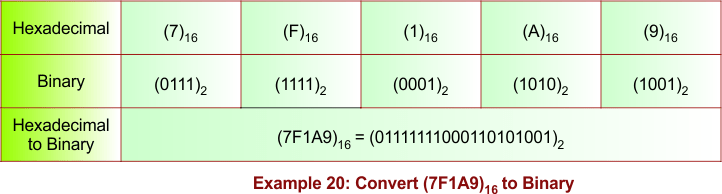
Description:
- The binary of 7₁₆ is 0111₂
- The binary of F₁₆ is 1111₂
- The binary of 1₁₆ is 0001₂
- The binary of A₁₆ is 1010₂
- The binary of 9₁₆ is 1001₂
(7F1A9)₁₆ = 01111111000110101001₂
Example 21: Convert (C0FFEE)₁₆ to Binary
Solution:
The following diagram shows the conversion of the hexadecimal number (C0FFEE)₁₆ into its equivalent binary.
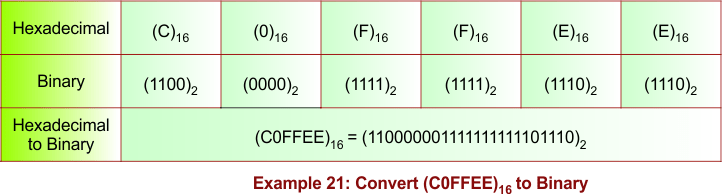
Description:
- The binary of C₁₆ is 1100₂
- The binary of 0₁₆ is 0000₂
- The binary of F₁₆ is 1111₂
- The binary of F₁₆ is 1111₂
- The binary of E₁₆ is 1110₂
- The binary of E₁₆ is 1110₂
(C0FFEE)₁₆ = 110000001111111111101110₂
Example 22: Convert (123ABC)₁₆ to Binary
Solution:
The following diagram shows the conversion of the hexadecimal number (123ABC)₁₆ into its equivalent binary.
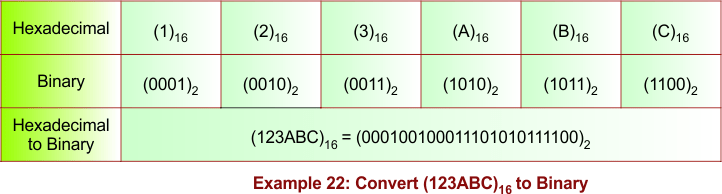
Description:
- The binary of 1₁₆ is 0001₂
- The binary of 2₁₆ is 0010₂
- The binary of 3₁₆ is 0011₂
- The binary of A₁₆ is 1010₂
- The binary of B₁₆ is 1011₂
- The binary of C₁₆ is 1100₂
(123ABC)₁₆ = 000100100011101010111100₂
Example 23: Convert (DEADBEEF)₁₆ to Binary
Solution:
The following diagram shows the conversion of the hexadecimal number (DEADBEEF)₁₆ into its equivalent binary.
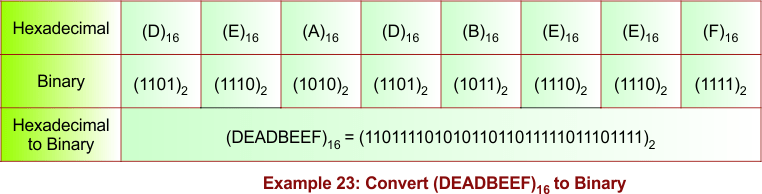
Description:
- The binary of D₁₆ is 1101₂
- The binary of E₁₆ is 1110₂
- The binary of A₁₆ is 1010₂
- The binary of D₁₆ is 1101₂
- The binary of B₁₆ is 1011₂
- The binary of E₁₆ is 1110₂
- The binary of E₁₆ is 1110₂
- The binary of F₁₆ is 1111₂
(DEADBEEF)₁₆ = 11011110101011011011111011101111₂
Example 24: Convert (5A1C9F)₁₆ to Binary
Solution:
The following diagram shows the conversion of the hexadecimal number (5A1C9F)₁₆ into its equivalent binary.
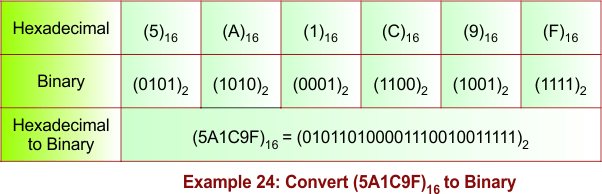
Description:
- The binary of 5₁₆ is 0101₂
- The binary of A₁₆ is 1010₂
- The binary of 1₁₆ is 0001₂
- The binary of C₁₆ is 1100₂
- The binary of 9₁₆ is 1001₂
- The binary of F₁₆ is 1111₂
(5A1C9F)₁₆ = 010110100001110010011111₂
Example 25: Convert (8F12AC)₁₆ to Binary
Solution:
The following diagram shows the conversion of the hexadecimal number (8F12AC)₁₆ into its equivalent binary.
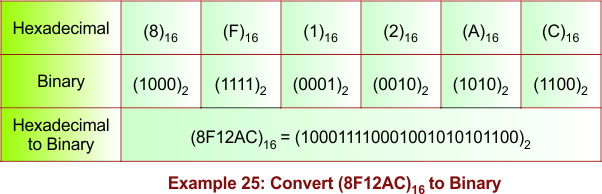
Description:
- The binary of 8₁₆ is 1000₂
- The binary of F₁₆ is 1111₂
- The binary of 1₁₆ is 0001₂
- The binary of 2₁₆ is 0010₂
- The binary of A₁₆ is 1010₂
- The binary of C₁₆ is 1100₂
(8F12AC)₁₆ = 100011110001001010101100₂
Example 26: Convert (FACE123)₁₆ to Binary
Solution:
The following diagram shows the conversion of the hexadecimal number (FACE123)₁₆ into its equivalent binary.
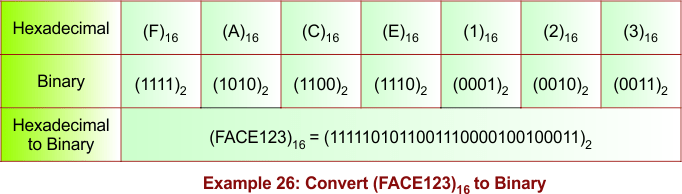
Description:
- The binary of F₁₆ is 1111₂
- The binary of A₁₆ is 1010₂
- The binary of C₁₆ is 1100₂
- The binary of E₁₆ is 1110₂
- The binary of 1₁₆ is 0001₂
- The binary of 2₁₆ is 0010₂
- The binary of 3₁₆ is 0011₂
(FACE123)₁₆ = 1111101011001110000100100011₂
Example 27: Convert (10BEEF)₁₆ to Binary
Solution:
The following diagram shows the conversion of the hexadecimal number (10BEEF)₁₆ into its equivalent binary.
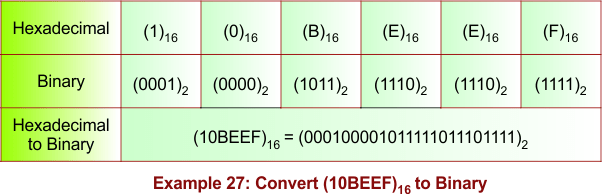
Description:
- The binary of 1₁₆ is 0001₂
- The binary of 0₁₆ is 0000₂
- The binary of B₁₆ is 1011₂
- The binary of E₁₆ is 1110₂
- The binary of E₁₆ is 1110₂
- The binary of F₁₆ is 1111₂
(10BEEF)₁₆ = 000100001011111011101111₂
Example 28: Convert (BADF00D)₁₆ to Binary
Solution:
The following diagram shows the conversion of the hexadecimal number (BADF00D)₁₆ into its equivalent binary.
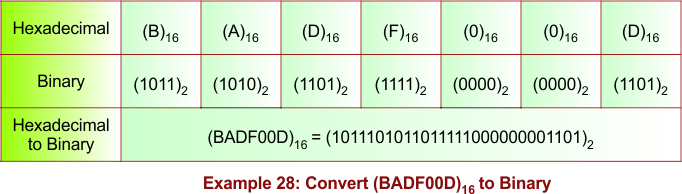
Description:
- The binary of B₁₆ is 1011₂
- The binary of A₁₆ is 1010₂
- The binary of D₁₆ is 1101₂
- The binary of F₁₆ is 1111₂
- The binary of 0₁₆ is 0000₂
- The binary of 0₁₆ is 0000₂
- The binary of D₁₆ is 1101₂
(BADF00D)₁₆ = 1011101011011111000000001101₂
Example 29: Convert (CAFEBABE)₁₆ to Binary
Solution:
The following diagram shows the conversion of the hexadecimal number (CAFEBABE)₁₆ into its equivalent binary.
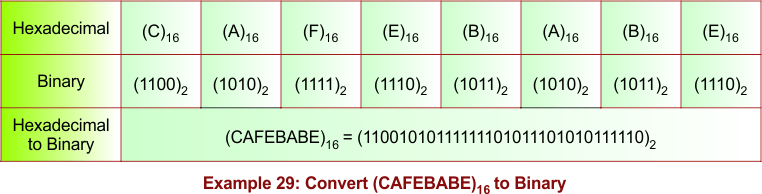
Description:
- The binary of C₁₆ is 1100₂
- The binary of A₁₆ is 1010₂
- The binary of F₁₆ is 1111₂
- The binary of E₁₆ is 1110₂
- The binary of B₁₆ is 1011₂
- The binary of A₁₆ is 1010₂
- The binary of B₁₆ is 1011₂
- The binary of E₁₆ is 1110₂
(CAFEBABE)₁₆ = 11001010111111101011101010111110₂
Example 30: Convert (FACEB00C)₁₆ to Binary
Solution:
The following diagram shows the conversion of the hexadecimal number (FACEB00C)₁₆ into its equivalent binary.
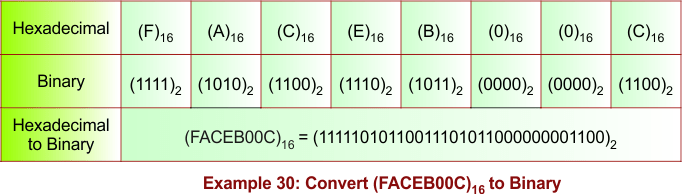
Description:
- The binary of F₁₆ is 1111₂
- The binary of A₁₆ is 1010₂
- The binary of C₁₆ is 1100₂
- The binary of E₁₆ is 1110₂
- The binary of B₁₆ is 1011₂
- The binary of 0₁₆ is 0000₂
- The binary of 0₁₆ is 0000₂
- The binary of C₁₆ is 1100₂
(FACEB00C)₁₆ = 11111010110011101011000000001100₂
2. Hexadecimal to Binary Conversion (Using Decimal Number System)
This method has two main Steps:
Step 1: Convert Hexadecimal to Decimal
- Write the given hexadecimal number
- Start from the rightmost digit
- Multiply each digit by powers of 16:
- Rightmost digit → × 16⁰
- Next digit → × 16¹
- Next → × 16² and so on
- Add all the results
The sum is your decimal number
For Fractional Part (if present)
Digits after the decimal use negative powers of 16:
First digit → × 16⁻¹
Next digit → × 16⁻²
Next → × 16⁻³
Step 2: Convert Decimal to Binary
- Take the decimal number
- Divide it by 2
- Write down the remainder
- Repeat division until the quotient becomes 0
- Write remainders in reverse order
This gives the binary result
Fractional Part (if present)
For decimal fractions, use the multiplication by 2 method to convert it into binary
- Take the fractional part
- Multiply it by 2
- Write down the integer part (0 or 1)
- Keep the fractional part only
Repeat until:- Fraction becomes 0 or
Required accuracy is reached
- Fraction becomes 0 or
Write the collected digits in the same order
Example 01: Convert (2A.3)₁₆ to Binary
Step 1: Convert Hexadecimal to Decimal
Integer Part (2A)₁₆ Conversion
- (2A)₁₆ = 2 × 16¹ + A × 16⁰
- (2A)₁₆ = 32 + 10
- (2A)₁₆ = (42)₁₀
Fractional Part (.3)₁₆ Conversion
- (0.3)₁₆ = 3 × 16⁻¹ = 3/16 = (0.1875)₁₀
Combine the integer and the fractional Part
- (2A)₁₆ + (0.3)₁₆ = (42)₁₀ + (0.1875)₁₀
- (2A.3)₁₆ = (42.1875)₁₀
Step 2: Convert Decimal to Binary
Integer Part (42)₁₀ Conversion
- 42 ÷ 2 = 21 remainder 0
- 21 ÷ 2 = 10 remainder 1
- 10 ÷ 2 = 5 remainder 0
- 5 ÷ 2 = 2 remainder 1
- 2 ÷ 2 = 1 remainder 0
- 1 ÷ 2 = 0 remainder 1
(42)₁₀ = (101010)₂
Fractional Part (0.1875)₁₀ Conversion
- 0.1875 × 2 = 0.375 → 0
- 0.375 × 2 = 0.75 → 0
- 0.75 × 2 = 1.5 → 1
- 0.5 × 2 = 1.0 → 1
(0.1875)₁₀ = (.0011)₂
Combine the integer and the fractional Part
- (42.1875)₁₀ = (101010.0011)₂
Hence, the given hexadecimal (2A.3)₁₆ is converted to binary (101010.0011)₂. so we can write
(2A.3)₁₆ = (42.1875)₁₀ = (101010.0011)₂
Example 02: Convert (7F.8)₁₆ to Binary
Step 1: Convert Hexadecimal to Decimal
Integer Part (7F)₁₆ Conversion
- (7F)₁₆ = 7 × 16¹ + F × 16⁰
- (7F)₁₆ = 112 + 15
- (7F)₁₆ = (127)₁₀
Fractional Part (.8)₁₆ Conversion
- (0.8)₁₆ = 8 × 16⁻¹ = 8/16 = (0.5)₁₀
Combine the integer and the fractional Part
- (7F)₁₆ + (0.8)₁₆ = (127)₁₀ + (0.5)₁₀
- (7F.8)₁₆ = (127.5)₁₀
Step 2: Convert Decimal to Binary
Integer Part (127)₁₀ Conversion
- 127 ÷ 2 = 63 remainder 1
- 63 ÷ 2 = 31 remainder 1
- 31 ÷ 2 = 15 remainder 1
- 15 ÷ 2 = 7 remainder 1
- 7 ÷ 2 = 3 remainder 1
- 3 ÷ 2 = 1 remainder 1
- 1 ÷ 2 = 0 remainder 1
(127)₁₀ = (1111111)₂
Fractional Part (0.5)₁₀ Conversion
- 0.5 × 2 = 1.0 → 1
(0.5)₁₀ = (.1)₂
Combine the integer and the fractional Part
- (127.5)₁₀ = (1111111.1)₂
Hence, the given hexadecimal (7F.8)₁₆ is converted to binary (1111111.1)₂. so we can write
(7F.8)₁₆ = (127.5)₁₀ = (1111111.1)₂
Example 03: Convert (A3.4)₁₆ to Binary
Step 1: Convert Hexadecimal to Decimal
Integer Part (A3)₁₆ Conversion
- (A3)₁₆ = A × 16¹ + 3 × 16⁰
- (A3)₁₆ = 160 + 3
- (A3)₁₆ = (163)₁₀
Fractional Part (.4)₁₆ Conversion
(0.4)₁₆ = 4 × 16⁻¹ = 4/16 = (0.25)₁₀
Combine the integer and the fractional Part
- (A3)₁₆ + (0.4)₁₆ = (163)₁₀ + (0.25)₁₀
(A3.4)₁₆ = (163.25)₁₀
Step 2: Convert Decimal to Binary
Integer Part (163)₁₀ Conversion
- 163 ÷ 2 = 81 remainder 1
- 81 ÷ 2 = 40 remainder 1
- 40 ÷ 2 = 20 remainder 0
- 20 ÷ 2 = 10 remainder 0
- 10 ÷ 2 = 5 remainder 0
- 5 ÷ 2 = 2 remainder 1
- 2 ÷ 2 = 1 remainder 0
- 1 ÷ 2 = 0 remainder 1
(163)₁₀ = (10100011)₂
Fractional Part (0.25)₁₀ Conversion
- 0.25 × 2 = 0.5 → 0
- 0.5 × 2 = 1.0 → 1
(0.25)₁₀ = (.01)₂
Combine the integer and the fractional Part
- (163.25)₁₀ = (10100011.01)₂
Hence, the given hexadecimal (A3.4)₁₆ is converted to binary (10100011.01)₂. so we can write
(A3.4)₁₆ = (163.25)₁₀ = (10100011.01)₂
Example 04: Convert (1F.9)₁₆ to Binary
Step 1: Convert Hexadecimal to Decimal
Integer Part (1F)₁₆ Conversion
- (1F)₁₆ = 1 × 16¹ + F × 16⁰
- (1F)₁₆ = 16 + 15
- (1F)₁₆ = (31)₁₀
Fractional Part (.9)₁₆ Conversion
- (0.9)₁₆ = 9 × 16⁻¹ = 9/16 = (0.5625)₁₀
Combine the integer and the fractional Part
- (1F)₁₆ + (0.9)₁₆ = (31)₁₀ + (0.5625)₁₀
(1F.9)₁₆ = (31.5625)₁₀
Step 2: Convert Decimal to Binary
Integer Part (31)₁₀ Conversion
- 31 ÷ 2 = 15 remainder 1
- 15 ÷ 2 = 7 remainder 1
- 7 ÷ 2 = 3 remainder 1
- 3 ÷ 2 = 1 remainder 1
- 1 ÷ 2 = 0 remainder 1
(31)₁₀ = (11111)₂
Fractional Part (0.5625)₁₀ Conversion
- 0.5625 × 2 = 1.125 → 1
- 0.125 × 2 = 0.25 → 0
- 0.25 × 2 = 0.5 → 0
- 0.5 × 2 = 1.0 → 1
(0.5625)₁₀ = (.1001)₂
Combine the integer and the fractional Part
- (31.5625)₁₀ = (11111.1001)₂
Hence, the given hexadecimal (1F.9)₁₆ is converted to binary (11111.1001)₂. so we can write
(1F.9)₁₆ = (31.5625)₁₀ = (11111.1001)₂
Example 05: Convert (B4.6)₁₆ to Binary
Step 1: Convert Hexadecimal to Decimal
Integer Part (B4)₁₆ Conversion
- (B4)₁₆ = B × 16¹ + 4 × 16⁰
- (B4)₁₆ = 176 + 4
- (B4)₁₆ = (180)₁₀
Fractional Part (.6)₁₆ Conversion
(0.6)₁₆ = 6 × 16⁻¹ = 6/16 = (0.375)₁₀
Combine the integer and the fractional Part
- (B4)₁₆ + (0.6)₁₆ = (180)₁₀ + (0.375)₁₀
(B4.6)₁₆ = (180.375)₁₀
Step 2: Convert Decimal to Binary
Integer Part (180)₁₀ Conversion
- 180 ÷ 2 = 90 remainder 0
- 90 ÷ 2 = 45 remainder 0
- 45 ÷ 2 = 22 remainder 1
- 22 ÷ 2 = 11 remainder 0
- 11 ÷ 2 = 5 remainder 1
- 5 ÷ 2 = 2 remainder 1
- 2 ÷ 2 = 1 remainder 0
- 1 ÷ 2 = 0 remainder 1
(180)₁₀ = (10110100)₂
Fractional Part (0.375)₁₀ Conversion
- 0.375 × 2 = 0.75 → 0
- 0.75 × 2 = 1.5 → 1
- 0.5 × 2 = 1.0 → 1
(0.375)₁₀ = (.011)₂
Combine the integer and the fractional Part
- (180.375)₁₀ = (10110100.011)₂
Hence, the given hexadecimal (B4.6)₁₆ is converted to binary (10110100.011)₂. so we can write
(B4.6)₁₆ = (180.375)₁₀ = (10110100.011)₂